Updated July 2026
Veeva runs roughly 80% of life sciences CRM. That's not in dispute. What's changed is the cost of staying: every team on the legacy Salesforce-based Veeva CRM is now facing a migration to Vault CRM before the old platform sunsets — a re-implementation project whether you stay or go. If you're going to re-implement anyway, it's worth asking whether the destination should be automatic.
This guide compares the credible alternatives, using the criteria medical affairs and commercial leaders actually evaluate on. TikaMobile is one of them — we've marked where we're genuinely strong and where another platform is the better call, because a rigged scorecard helps nobody and you'd spot it anyway.
Quick answer: The strongest Veeva alternatives depend on your situation: TikaMobile for small-to-mid-size medical affairs and field teams that need purpose-built workflows and high adoption; Salesforce Life Sciences Cloud for enterprises standardizing on the Salesforce ecosystem; IQVIA OCE for organizations that want CRM fused with IQVIA's data assets; CloseUp CRM for emerging-markets commercial teams. Intelligence layers like Definitive Healthcare and Sorcero complement rather than replace a CRM.
Why teams are re-evaluating now
Three things converged to make this a real decision again:
- The Vault CRM migration. Veeva is moving customers off its Salesforce-based CRM to Vault CRM — around 140 deployments were live by the end of FY2026, and 10 of the top 20 biopharmas have committed. For everyone else, a migration is on the calendar.
- Salesforce entered the market directly. Life Sciences Cloud went GA in October 2025 (now branded Agentforce Life Sciences), with AstraZeneca, Novartis, Takeda, and Pfizer among announced customers. IQVIA is partnering with Salesforce while supporting OCE through 2029.
- The AI gap opened. CRM re-platforming cycles are long; AI product cycles are short. Teams comparing platforms in 2026 are comparing AI roadmaps as much as feature lists.
A migration you didn't choose is still a procurement event. The question is whether your next platform gets picked by default or by evaluation.
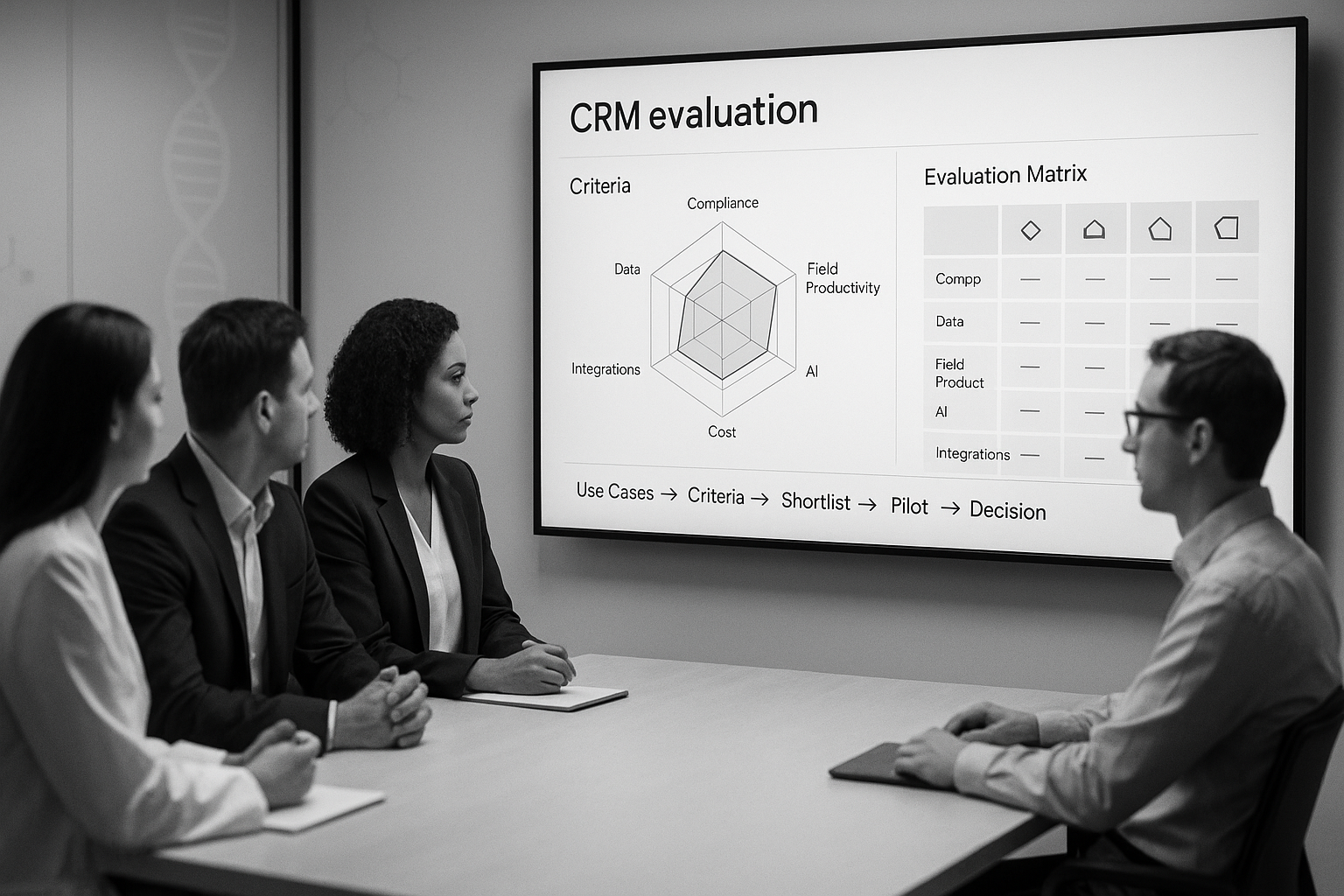
How to evaluate a Veeva alternative: 7 criteria that matter
Roundups love feature grids. Buying committees care about a shorter list:
- Purpose-built vs. adapted — does the platform treat medical affairs as a first-class workflow (KOL tiering, scientific exchange documentation, MIR handling) or as a module bolted onto a sales CRM?
- Adoption reality — what percentage of licensed users actually work in the system after month three? Shelfware is the most expensive line item in this category.
- Implementation lift — an IT program measured in quarters, or a team onboarding measured in weeks-to-months?
- Compliance posture — audit trails, data privacy, validation. If you need 21 CFR Part 11 validation out of the box, say so early; it narrows the field fast.
- Field usability — offline access, mobile experience, and how many taps it takes an MSL to log an interaction between meetings at congress.
- AI that does work — insight synthesis, KOL identification, pre-call preparation — versus AI that's a chatbot on top of the same screens.
- Total cost trajectory — license plus implementation plus customization plus the internal admin headcount the platform assumes.
The alternatives, honestly assessed
TikaMobile — purpose-built for medical affairs and field teams
TikaMobile has built life sciences CRM, BI, and AI since 2013, with purpose-built modules rather than one generic platform: TikaMSL for medical affairs and MSL teams, TikaPharma for commercial, TikaMedInfo for medical information request management, and TikaDiscover for AI-driven KOL identification. The platform reports a 94% utilization rate across 5,000+ users — adoption is the metric we lead with, because unused seats are where CRM budgets go to die.
Where it's strong: MSL-specific workflows — KOL tiering and engagement planning, insights capture, conference planning, and MIR routing — ship as the core product, not add-ons. Implementation is agile rather than validation-gated: typically faster and materially cheaper than an enterprise Veeva program.
Where it isn't: if you need pre-validated 21 CFR Part 11 workflows out of the box, global-scale deployment across tens of thousands of commercial reps, or the Vault content ecosystem for MLR pipelines, Veeva's depth there is real and we won't pretend otherwise. TikaMobile integrates with existing CRMs, so medical affairs can run purpose-built while commercial stays put.
Best fit: small-to-mid-size pharma, biotech, and device companies — or medical affairs organizations inside larger companies — that want field teams actually using the system. Details on the medical affairs CRM page.
IQVIA OCE — CRM fused with the industry's largest data asset
IQVIA's Orchestrated Customer Engagement pairs CRM with IQVIA's healthcare data and a Next-Best-Action engine. If your engagement model runs on data-driven targeting at scale, that fusion is genuinely differentiated. Consider the timeline, though: IQVIA has committed to supporting OCE through 2029 while partnering with Salesforce on Life Sciences Cloud — buyers should ask hard questions about the platform's long-term destination.
Salesforce Life Sciences Cloud — the enterprise ecosystem play
GA since October 2025 and now branded Agentforce Life Sciences, this is Salesforce reclaiming the vertical it once powered through Veeva. Announced customers include AstraZeneca, Novartis, Takeda, and Pfizer, and mobile/offline capabilities have reached competitive parity. It's the credible enterprise choice if you're standardizing on Salesforce — with enterprise implementation lift to match. Medical affairs teams should scrutinize how much of the workflow is native versus configured.
CloseUp CRM — the emerging-markets value option
CloseUp reports 47,000 users across 50+ countries with strength in the Americas, integrating prescription and sales data at a price point mid-market commercial teams like. Less depth on medical affairs workflows; strongest as a commercial CRM in its home regions.
Exeevo Omnipresence — omnichannel engagement for enterprise
Exeevo positions on Microsoft's cloud with omnichannel HCP engagement, and Gartner Peer Insights lists it among recognized Veeva CRM alternatives. Worth a look for Microsoft-standardized IT environments.
Definitive Healthcare and Sorcero — intelligence layers, not CRMs
Two names that show up in alternative searches but answer a different question: Definitive Healthcare is a commercial intelligence engine (market forecasting, provider data), and Sorcero is medically-tuned AI for literature and safety-signal analysis. Either can sit alongside any CRM on this list. Neither replaces one — if a roundup tells you otherwise, close the tab.
Comparison at a glance
| Criteria | TikaMobile | Veeva (Vault CRM) | Salesforce LSC | IQVIA OCE |
|---|---|---|---|---|
| Medical affairs workflows | Purpose-built (TikaMSL) | Strong, ecosystem-integrated | Configurable, newer | Data-led, commercial focus |
| MIR management | Built-in (TikaMedInfo) | Vault MedInquiry | Via configuration | Not a core focus |
| 21 CFR Part 11 out of box | Standard healthcare validation | Pre-validated | Enterprise validation program | Enterprise validation program |
| Typical implementation | Agile, faster deployment | Quarters (validation-gated) | Quarters (enterprise program) | Quarters |
| Best-fit org size | SMB to mid-market; MA teams anywhere | Enterprise | Enterprise on Salesforce stack | Enterprise, data-driven |
| Reported adoption | 94% utilization (company-reported) | Not published | Not published | Not published |
| AI approach | Conversational AI + KOL discovery, monthly releases | Configurable agents, quarterly releases | Agentforce agents | Next-Best-Action engine |
| Platform trajectory | Independent, medical-affairs-focused | Vault migration underway | New entrant, heavy investment | Supported through 2029; Salesforce partnership |
Based on publicly available vendor documentation as of July 2026. Verify current capabilities directly with each vendor during evaluation.
If purpose-built medical affairs workflows and adoption are what you're solving for, TikaMobile takes 20 minutes to evaluate properly.
Book a 20-minute demoQuestions to ask every vendor before you decide
- Is medical affairs a native workflow or a configured module? Ask to see KOL tiering, an insights capture, and an MIR handled end-to-end in the demo — not slides.
- What does implementation actually require from my team — an IT program with validation gates, or onboarding?
- What percentage of licensed users are active monthly across your customer base?
- If we're on legacy Veeva CRM: what does the Vault migration cost us in re-configuration, retraining, and re-validation — and what would the same budget buy elsewhere?
- How does your AI handle field-captured insights — synthesis and routing, or storage?
- Which of your referenced customers looks like us in size and therapeutic area?
Frequently asked questions
What is the best Veeva alternative for medical affairs teams?
For medical affairs specifically, purpose-built platforms beat adapted sales CRMs. TikaMobile's TikaMSL is built around MSL workflows — KOL management, insights capture, and medical information requests — and reports 94% platform utilization. Enterprise teams standardizing on Salesforce should also evaluate Life Sciences Cloud.
Why are companies leaving Veeva CRM?
Most aren't leaving so much as being moved: the legacy Salesforce-based Veeva CRM is being replaced by Vault CRM, which means a migration project either way. Teams use that forced re-implementation to re-evaluate cost, adoption, and fit — especially mid-size organizations paying enterprise prices for partially used platforms.
Is Salesforce Life Sciences Cloud a real Veeva competitor?
Yes. It reached general availability in October 2025, has announced customers including AstraZeneca, Novartis, Takeda, and Pfizer, and has invested heavily in mobile and offline parity. It's an enterprise-scale option; evaluate how much medical affairs workflow is native versus configured.
How much does a Veeva alternative cost?
Pricing across this category is quote-based and varies with users, modules, and validation requirements. The structural difference: enterprise suites price for global scale and validation programs; purpose-built platforms like TikaMobile price for mid-market teams and include customization in the base offering.
Can TikaMobile coexist with Veeva?
Yes — a common pattern is commercial staying on an incumbent CRM while medical affairs runs TikaMSL, integrated so data flows between them. That avoids forcing one platform to serve two very different jobs.
The bottom line
Veeva earned its market position, and for global enterprise deployments with deep validation needs it remains the safe answer. But “safe” is doing a lot of work in a year when staying put still means re-implementing. If your medical affairs or field team is the one living in the system daily, evaluate at least one purpose-built platform before you sign the migration SOW.
If purpose-built workflows, fast implementation, and adoption your team won't fight are on your shortlist, TikaMobile is worth a look — it takes 20 minutes to see whether it fits your model.
See exactly how MSL teams run KOL management, insights, and MIRs in TikaMobile.
Book a 20-minute demo